


By Professor Toto | Broadcasting LIVE from TOTO-TOWN with the Titanium Mic of Magnanimity TOTO FREE PRESS — Tomorrow’s News Today
Pour the coffee. Sit down. Turn off the TV.
Because what I’m about to tell you, CNN can’t explain. Fox hasn’t connected. MSNBC is still sounding out the word “Hormuz.” And the State Department — bless their hearts — is still pretending there’s a rational adult on the other end of the phone in Tehran.
There isn’t.
There hasn’t been one since February.
What there IS — is a Foreign Minister with a Twitter account and a Revolutionary Guard with a navy.
And yesterday, those two things had a very public divorce.
THE DAY THE MARKETS GOT WHIPLASH
Let me walk you through the tape.
8:45 in the morning, Eastern time.
Iran’s Foreign Minister — a veteran diplomat named Abbas Araghchi — logs onto X and announces to every oil trader, every shipping company, every central banker on planet Earth that the Strait of Hormuz is completely open.
Twenty-one minutes later, at 9:06 AM, President Trump thanks Iran for the reopening.
The markets go absolutely vertical.
-
U.S. crude collapses over 11%.
-
Dow jumps 868 points — after briefly spiking 1,100.
-
Wall Street hits a record.
-
Shipping stocks explode.
-
Commodity traders start high-fiving in Singapore.
For about three hours, the world believed peace had arrived.
Then the phone rang in Tehran.
Except it wasn’t the Foreign Minister answering.
It was the Revolutionary Guard.
THE REBUKE HEARD ‘ROUND THE WORLD
By afternoon, Iran’s Parliament Speaker announced the deal was scrapped.
Then the Islamic Revolutionary Guard Corps — the IRGC — released their own statement, and I want you to read this carefully:
“Passage is only possible with the permission of the IRGC Navy.”
Not the Foreign Minister’s permission. Not the President of Iran’s permission. Not the Parliament’s permission.
The IRGC’s permission.
And then it got uglier.
The IRGC’s own news agency publicly slammed Iran’s Foreign Minister — their own government’s top diplomat — accusing him of a “complete lack of tact in information dissemination.”
A second IRGC-linked outlet said his tweet had “plunged Iranian society into an atmosphere of confusion.”
Then somebody — and God bless ‘em — leaked the audio from the IRGC Navy itself:
“We will open it by the order of our leader — not by the tweets of some idiot.”
IDIOT.
Iran’s military. On an open channel. Calling Iran’s Foreign Minister. An IDIOT.
Meanwhile — and this is not a drill — IRGC gunboats were busy firing on an Indian oil tanker called the Sanmar Herald. Audio surfaced of the captain pleading with the Revolutionary Guard to stop shooting.
So let me summarize what the world watched happen yesterday, live, with the Dow hanging in the balance:
-
The Foreign Minister said peace.
-
The military said war.
-
The military called the Foreign Minister an idiot.
-
The military shot at a tanker while the Foreign Minister was still tweeting about peace.
That’s not diplomacy.
That’s not confusion.
That’s not a “mixed message.”
That’s a state eating itself in front of a live studio audience.
WHY THIS IS HAPPENING — AND WHY NOBODY IN WASHINGTON WILL SAY IT
Here’s the secret the bow-tie boys on the cable shows don’t understand. And if they DO understand it, they won’t say it out loud because it destroys the entire diplomatic fantasy they’ve been peddling for thirty years.
Iran is not one country with one government.
Iran is two governments wearing one flag.
One government is the civilian republic. The President. The Parliament. The Foreign Ministry. The guys who go to the UN and wear suits and talk about the JCPOA and nuclear inspections and regional stability. The guys negotiating with JD Vance in Islamabad right now.
The other government is called the Islamic Revolutionary Guard Corps — the IRGC.
Two capitals. Two budgets. Two militaries. Two foreign policies.
One nation.
Zero chain of command between them.
And the reason this has been a ticking time bomb for decades is exactly why the snake grew two heads in the first place.
1979: THE YEAR OF TWO SERPENTS
Rewind the tape to 1979.
The Shah has just fallen. Ayatollah Khomeini steps off the plane from Paris and takes Tehran.
He’s got a problem.
Iran has a real military — the Artesh. Professional. Uniformed. Navy, army, air force. But every one of those officers swore an oath of loyalty to the Shah.
Khomeini doesn’t trust them. He can’t purge them — he needs somebody to patrol the borders. But he knows, bone-deep, that a military loyal to the old king is a dagger pointed at a new revolution.
So he does the one thing no sane country ever does.
He builds a second army.
Right next to the first one.
He calls it the Islamic Revolutionary Guard Corps. Its job is not to defend Iran. Its job is to defend the revolution. And more specifically, him.
Two militaries. Same country. Two chains of command. Two uniforms. Two loyalties.
One nation, two serpents.
The Artesh defends the borders.
The IRGC defends the throne.
That was 1979. Forty-six years ago.
WHAT THE SNAKE BECAME
You’d think a parallel revolutionary guard would stay a small, ideological praetorian unit. A few thousand true believers. A ceremonial force.
Oh, it did not.
Over four and a half decades, the IRGC metastasized into something that no American — not even the CIA, not even Langley’s best analysts — truly comprehends.
Today, the Revolutionary Guard controls:
-
Construction. Through a conglomerate called Khatam al-Anbia — Iran’s largest engineering firm. Dams. Pipelines. Ports. Roads. Highways.
-
Transportation. Shipping lines. Freight. Rail. Customs.
-
Telecommunications. The phone lines. The cell towers. The internet itself.
-
Banking. Entire banks. Plural.
-
Insurance.
-
Oil and gas. With no-bid contracts going back thirty years.
-
Agriculture.
-
Real estate.
-
Pharmaceuticals.
-
Mining.
-
Tehran’s international airport. They literally forced a Turkish contractor out and took the airport for themselves.
-
The shadow tanker fleet that spent years laundering Iranian oil past Western sanctions.
-
An enormous black-market smuggling network operating through IRGC-controlled ports and airport terminals outside customs jurisdiction.
-
The missiles.
-
The nuclear program.
-
The proxy networks — Hezbollah, the Houthis, Iraqi militias.
After decades of post-war reconstruction and a 2006 Supreme Leader decree that opened Article 44 of the constitution to “non-governmental” entities, the IRGC swallowed entire industries whole.
Credible estimates from Reuters, Clingendael, and the Middle East Institute place IRGC-affiliated enterprises at somewhere between one-third and two-thirds of Iran’s entire GDP.
A third. Possibly two-thirds. Of a whole nation’s economy.
Their budget? Classified.
Their taxes? None.
Their accountability to elected officials? Zero.
Reuters — not talk radio, Reuters — describes the IRGC as “a state-within-a-state.”
That’s what the other head of the snake actually is.
Not an army. An empire.
THE SEVENTEEN TAILS
And here’s what makes the two-headed snake even harder to kill.
The IRGC didn’t just build an empire inside Iran. It built franchises.
Hezbollah in Lebanon. The Houthis in Yemen. Kata’ib Hezbollah in Iraq. Palestinian Islamic Jihad in Gaza. The Popular Mobilization Forces across the Fertile Crescent.
These are not “Iranian proxies” in the cutesy way CNN uses the word — as if Tehran sends a memo and the militias salute. These are IRGC subsidiaries. They have their own commanders. Their own weapons caches. Their own revenue streams. Some of which the IRGC itself no longer fully controls anymore.
Which means even if you decapitate the IRGC leadership — as Israel partially did in June of 2025 — the franchises keep operating.
You are not dealing with a snake with two heads.
You are dealing with a snake with two heads — and seventeen tails, each with its own nervous system, each capable of striking on its own, each funded by its own black-market cash flow.
Cut off the head in Tehran, and a tail in Yemen lashes a Saudi pipeline.
Cut off a tail in Beirut, and a head in Qom orders another missile launch.
This is not a state.
This is a hydra with a flag.
A THIRD HEAD MAY BE GROWING
And now — brace yourself — because I’ve identified the civilian head and the IRGC head, but there is a third power center your neighbors need to know exists.
Iran’s nuclear scientists.
The Atomic Energy Organization of Iran — the AEOI — operates in a semi-autonomous space that cleanly belongs to neither the Foreign Ministry nor the IRGC. It is partly funded through IRGC channels. It is nominally under presidential authority. But since Khamenei’s death in February, it is practically answerable to… nobody.
When you don’t know who controls the centrifuges, you don’t know who controls the trigger.
The snake may have two heads biting each other in public.
But the venom sac has its own address.
And nobody in Washington is talking about it.
Professor Toto will have more on this in a future dispatch from TOTO-TOWN. Stay tuned.
AND THEN WE CUT THE HEAD OFF — AND THE GUARD PICKED THE NEXT ONE
For forty-six years there was one man — and only one man — who could give the IRGC an order it would actually obey.
Ayatollah Ali Khamenei. The Supreme Leader.
He alone appointed the IRGC commander. He alone signed their budget. He alone had the religious and revolutionary authority to make the snake do what he wanted.
In June of 2025, Israeli strikes killed the IRGC’s commander-in-chief, Hossein Salami, along with numerous senior officers.
On February 28th of 2026, U.S. and Israeli forces took out Khamenei himself.
Dead.
Gone.
And then something remarkable happened — something the American press has almost entirely buried.
The Assembly of Experts — the 88 clerics constitutionally responsible for picking the next Supreme Leader — held an emergency vote. Khamenei’s own written will said he did NOT want his son to succeed him.
The IRGC overrode the will.
According to Reuters, citing five senior Iranian sources, the Revolutionary Guard forced through the selection of Khamenei’s 55-year-old son, Mojtaba, as the new Supreme Leader. They pressured the Assembly. They threatened critics. They delayed the announcement by hours while crushing internal opposition.
On March 9th, 2026, Mojtaba Khamenei was declared the third Supreme Leader of the Islamic Republic.
On the same day, the IRGC pledged him “complete obedience and self-sacrifice.”
The networks reported those words as if they were normal.
They are not normal.
Because Alex Vatanka at the Middle East Institute saw it for what it was, and said so out loud:
“Mojtaba owes his position to the Revolutionary Guards, and as such he is not going to be as supreme as his father was.”
The Jerusalem Post put it even sharper — calling Mojtaba “a figurehead,” “a mask,” “a cover” for IRGC rule. His first statement as Supreme Leader wasn’t even delivered in person. It was read aloud by a state TV anchor over a still photograph. He hasn’t been seen in public. He may be wounded. He may be hiding. He may be, in some deep sense, a hostage.
What matters is this:
The new Supreme Leader of Iran did not choose the Revolutionary Guard.
The Revolutionary Guard chose HIM.
And a Supreme Leader who owes his throne to the IRGC is not a Supreme Leader who commands the IRGC.
He is their chaplain.
He blesses what they have already decided. He reads statements they have already written. He sanctifies decisions he had no hand in making.
That’s what the world watched happen yesterday.
The IRGC shot at a tanker. Araghchi tweeted about peace. Mojtaba sat silent — invisible, unheard, possibly unable — while the civilian diplomats and the Revolutionary Guard contradicted each other in real time on the world stage.
This is not a Supreme Leader.
This is a throne with a corpse propped up in it, while the real power hides behind the curtain and pulls the strings.
And every American diplomat still pretending otherwise is either lying to the public or lying to himself.
WHAT ARAGHCHI ACTUALLY KNOWS
Here’s the part that should keep you up at night.
Abbas Araghchi is not a fool.
He has a PhD. He has served in the Iranian diplomatic corps for decades. He survived Rouhani. He survived Raisi. He’s serving Pezeshkian now.
He knows EXACTLY what the IRGC is.
Which means when he tweets about open straits, he is not confused. He is not misinformed. He is not operating on bad intelligence.
He is a man standing in front of a burning building, telling you the fire department is on the way — because the alternative is admitting, on the record, to the entire world, that he has no authority over the arsonist.
The tragedy of Islamabad is not that Iran is negotiating in bad faith.
The tragedy is that Iran’s negotiators are negotiating in good faith — about a fire they cannot put out.
Araghchi is not lying to the world.
Araghchi is lying to himself — because the alternative is admitting the Islamic Republic no longer has a functioning government.
And when a man of that intelligence, that experience, and that track record cannot bring himself to say the obvious out loud… you have not witnessed a diplomatic failure.
You have witnessed the quiet humiliation of an entire civilian state.
SO WHAT DOES TRUMP DO?
Here’s what Professor Toto sees from the top of the TOTO-TOWN signal tower.
The diplomats in Islamabad cannot deliver anything the Revolutionary Guard doesn’t approve of first. That’s the iron fact. Every policy option from here flows out of that single reality.
Which means the answer isn’t diplomacy OR military action. The answer is an escalation ladder — with real, credible, sequential rungs — aimed squarely at the IRGC’s commercial empire, not at the Iranian people.
Rung One: Stop pretending. Declare publicly — from the Resolute Desk — that any agreement signed by Iran’s civilian government must be countersigned or endorsed by the IRGC command to be binding. Force the Revolutionary Guard into the room. No more hiding behind Araghchi.
Rung Two: Coalition tanker escort. Reflag shipping. Put U.S., Gulf Cooperation Council, and allied warships in the Strait. This is not hypothetical — it’s the exact playbook that worked in 1987.
Rung Three: Secondary sanctions on IRGC oil buyers. China is the big customer. Hit the Chinese refineries taking IRGC-linked crude. You don’t need to bomb Kharg Island — you just need to make Kharg’s oil unsellable.
Rung Four: If the IRGC escalates anyway — as they did in 1988 — the U.S. Navy has every legal and historical precedent to engage IRGC naval assets directly, as Reagan did during Operation Praying Mantis.
Four rungs. Each one calibrated. Each one targeting the IRGC’s wallet before its weapons. Each one with a real-world precedent.
You don’t bomb the head of the snake. You starve the belly.
You don’t attack Iran. You attack the empire inside Iran.
And you do it in stages — so every IRGC commander from Tehran to Bandar Abbas is watching his own bank account bleed, week by week, and calculating whether loyalty to a figurehead Supreme Leader is worth the personal price.
That is the path to a real deal.
Every other path is theater.
REAGAN FIGURED THIS OUT IN 1987
And before anybody calls this reckless, naïve, or some kind of cowboy escalation — let me remind you this is not a novel idea.
Ronald Reagan figured it out in 1987.
The year was 1987. The place was the Persian Gulf. Iran — then, as now — was using its navy and its Revolutionary Guard fast-attack boats to harass tankers. Reagan launched a naval escort mission called Operation Earnest Will. The U.S. Navy reflagged Kuwaiti tankers as American vessels and began escorting them through the Gulf.
When the IRGC kept firing, the U.S. Navy started firing back.
In April of 1988, we launched Operation Praying Mantis — the largest U.S. surface naval engagement since World War II. We sank two Iranian frigates, a gunboat, and several other vessels. We destroyed Iranian oil platforms.
And then, within months, Iran — the Ayatollah Khomeini himself — accepted a UN ceasefire resolution he had called a “poisoned chalice.”
Why?
Because the IRGC calculated the cost to their commercial empire.
They didn’t back down because they feared American military power.
They backed down because they feared American disruption of THEIR economic power.
Reagan didn’t negotiate with the snake.
He stepped on its wallet.
Trump has the same option available to him today. The same Gulf. The same choke points. The same IRGC naval doctrine. The same commercial pressure points.
The only question is whether anyone in the current West Wing has bothered to read the 1988 file.
THE IRON LAW FROM TOTO-TOWN
Write this one on your refrigerator. Forward it to your congressman. Read it twice before you turn off the lights tonight:
You cannot make peace with half a government.
You can only make peace with whoever holds the trigger.
Right now, in Tehran, the trigger is not in the diplomats’ hands. It’s in the IRGC’s hands.
And until Washington accepts that, we will keep watching the Strait open and close on the same day. We will keep watching the Dow jump eight hundred points in the morning and give it all back by sundown. We will keep watching oil tankers burn while Foreign Ministers tweet. We will keep pretending that “Iran” is a country instead of a hostage situation.
THE BOTTOM LINE
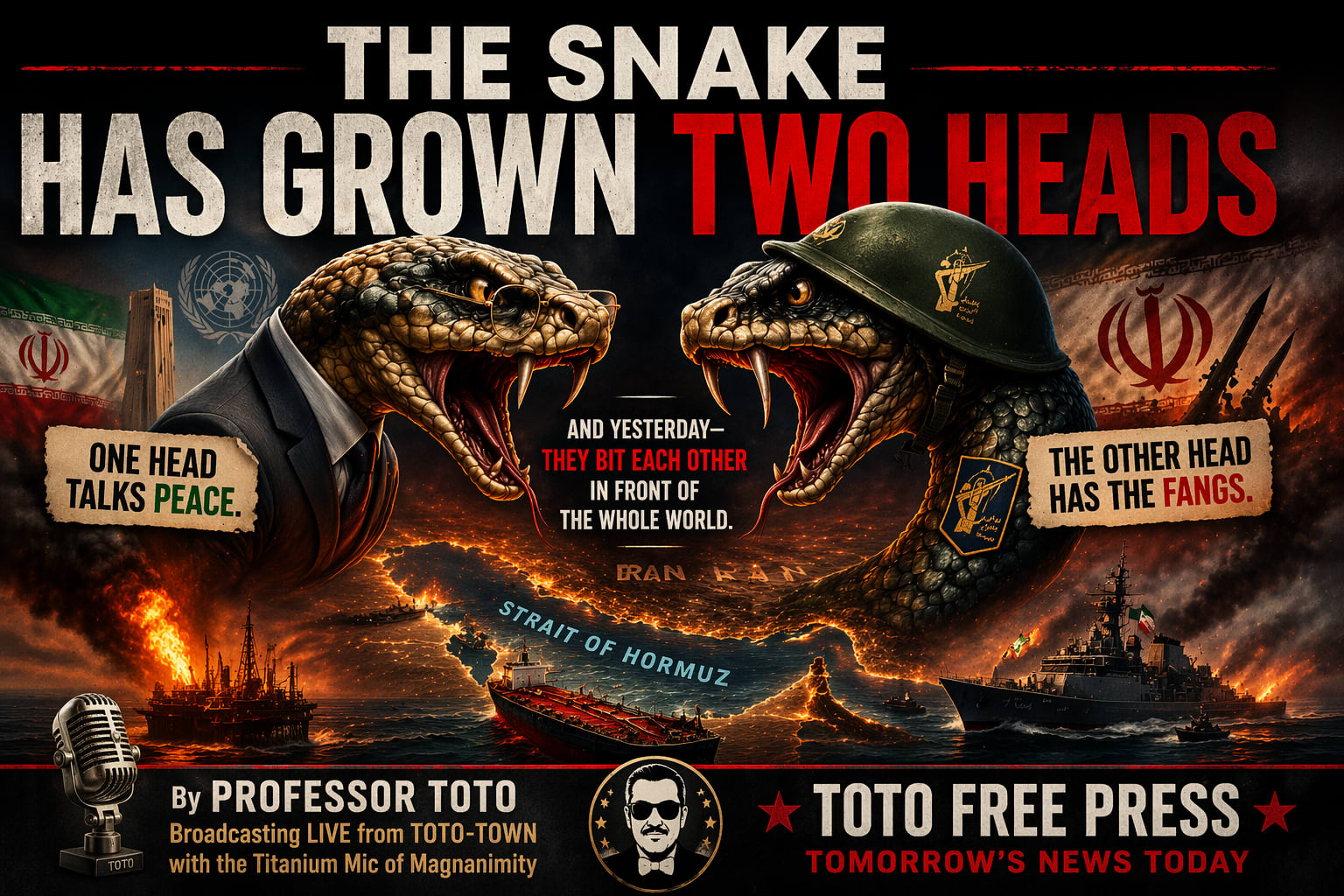
The snake has grown two heads.
One head wears a suit. One head wears a uniform.
One head speaks at the UN. One head controls the guns, the oil, the missiles, and the money.
And yesterday, for the first time in forty-six years, the two heads of the snake turned around and bit each other in front of the whole world.
The civilian head said peace. The fanged head said war. The fanged head called the civilian head an idiot. The markets believed the civilian head for about three hours. Then they looked at the fangs.
Every American paying attention saw it happen.
And every American commentator still calling this a “negotiation” is either lying to you, lying to themselves, or — and I say this with all the Limbaughvian love I can muster — is simply not paying attention.
The snake has two heads.
It will keep biting itself until one head wins.
Or until an outside force decides which head to deal with.
The question for the Trump administration is simple:
Which head are we negotiating with?
Because if the answer is “the one with the microphone,” we’ve already lost.
If the answer is “the one with the fangs” — then it’s time to stop sending diplomats to Islamabad and start sending Navy escorts into the Strait, sanctions onto the Chinese refineries, and pressure onto the IRGC’s wallet.
Everything else is theater.
IMPERIUM IN IMPERIO
The Romans had a phrase for what Iran has become.
Imperium in Imperio.
An empire within an empire.
Every civilization that has tried to negotiate with an Imperium in Imperio — while pretending the civilian government was in charge — has eventually learned the same lesson.
Usually the hard way.
Usually at great cost.
Usually in a strait.
The Persian Empire fell at the Strait of Salamis.
The Byzantine Empire fell at the Strait of the Bosphorus.
The British Empire faltered at the Strait of Suez.
And the American Empire — if it is not careful — may discover its own lesson at the Strait of Hormuz.
Where the snake waits.
With two heads.
And seventeen tails.
And a venom sac that answers to no one.
And Now You Know…
THE BEST of the Story.
Professor Toto broadcasts nightly from TOTO-TOWN with the Titanium Mic of Magnanimity. Subscribe at ProfessorToto.Substack.com and TotoFreePress.com — Tomorrow’s News Today.