

By Professor Toto | TOTO FREE PRESS — Tomorrow’s News Today
Folks…
Pull up a chair. Pour the coffee. Because what happened in Richmond, Virginia today is the most important political ruling of 2026 — and almost nobody is connecting it to the dot it was always meant to connect to.
Today, May 8, 2026, the Supreme Court of Virginia handed down a 4-to-3 ruling — a 46-page opinion authored by Justice D. Arthur Kelsey — that threw out an election the Democrats already won.
Read that again, folks. Slowly.
They threw out an election the Democrats already won.
Three million Virginians cast ballots. The “Yes” side carried the day by roughly three points. The Governor — Democrat Abigail Spanberger — called it a mandate. The maps were drawn. The seats were counted. The midterm strategy was locked and loaded.
And the court — the actual court of the actual Commonwealth of Virginia — looked at all of that and said four words that ought to be carved into stone over every state capitol in this country:
“Constitutions should not be changed lightly.”
The vote was nullified. The map is dead. The 2026 midterms in Virginia will be run on the existing court-drawn maps. Four congressional seats Democrats were trying to vaporize are still standing.
And here is the part nobody on cable news will tell you tonight:
This is exactly — EXACTLY — what should have happened in 2020.
What Actually Happened in Virginia
Let’s get the facts on the table, because the regime media is already spinning this thing into a pretzel.
In October 2025, with early voting already underway for Virginia’s House of Delegates elections, the Democrat-controlled General Assembly rammed through the first passage of a constitutional amendment designed to redraw Virginia’s congressional map mid-decade. The proposed map would have flipped Virginia’s congressional delegation from 6-Democrat / 5-Republican to a stunning 10-Democrat / 1-Republican blowout.
That’s right. They were trying to vaporize four Republican seats. In one move. Mid-decade. With no census. No commission. No process.
Just raw partisan power.
But here’s the catch, folks — and pay attention because this is the whole ballgame:
Virginia’s Constitution, Article XII, Section 1, says you cannot amend the document on a whim. You must:
-
Pass it through the General Assembly once.
-
Hold an intervening House of Delegates general election.
-
Pass it through the General Assembly a second time with the new legislature.
-
Then — and only then — send it to the people for a referendum.
The whole point is to make sure that the voters get to weigh in on the legislature before that legislature locks in a permanent change to the supreme law of the state.
It’s not complicated. It’s not partisan. It’s the rules.
Democrats skipped step two.
They passed the amendment on October 31, 2025 — after early voting had already begun for the November 2025 House elections. More than 1.3 million Virginians had already started casting their ballots before the General Assembly even held the first vote.
Then they passed it a second time in January 2026, certified the referendum for April 21, 2026, and won — by a razor-thin 51 to 49 margin.
Republican lawmakers and a member of Virginia’s redistricting commission sued. Tazewell County Circuit Judge Jack Hurley, Jr. agreed in January that the process was unconstitutional. Democrats appealed. The Supreme Court of Virginia let the referendum go forward but reserved the right to rule on the law later.
Today, they ruled.
The court’s reasoning was airtight: under Virginia’s Constitution, “general election” includes the early voting period — not just Election Day. Once early voting begins, the election has begun. Period. And because Democrats passed the amendment after early voting started, there was no intervening election — the Constitution’s most important procedural safeguard was bulldozed.
Justice Kelsey’s words: that violation “incurably taints the resulting referendum vote and nullifies its legal efficacy.”
Translation: it doesn’t matter how many people voted. It doesn’t matter who won. The process was broken. The vote is void.
Now Let Me Tell You Why This Matters
Here is the lesson nobody on the right has been able to articulate clearly for five long, painful years:
We do not live in a democracy. We live in a constitutional republic.
In a pure democracy, the majority wins. Period. Fifty-one percent rule the other forty-nine, and what they say goes.
In a republic — a constitutional republic — the rules rule. The majority does not get to break the rules to win. The process is the protection. The Constitution is the firewall.
When a state changes the rules of an election outside the proper constitutional channels, the vote itself becomes illegitimate — not because the people didn’t vote, not because the count was wrong, but because the playing field was rigged before the first ballot was cast.
That is what the Virginia Supreme Court ruled today.
And that — folks — is precisely what should have been ruled in 2020.
The 2020 Parallel That Will Make Your Blood Boil
Pause for a moment.
In 2020, in state after state — Pennsylvania, Michigan, Wisconsin, Georgia — the same exact constitutional violation occurred. Not similar. Not analogous. The same exact violation.
In Pennsylvania, Secretary of State Kathy Boockvar — a Democrat appointee — issued last-minute guidance changing the rules for mail-in ballot ID verification two days before the election. The Pennsylvania Constitution, like Virginia’s, does not give the Secretary of State the power to rewrite election law. That power belongs to the legislature. Period.
A Pennsylvania court later confirmed it: Boockvar “lacked statutory authority” to issue that guidance. She did it anyway.
The Pennsylvania Supreme Court — a partisan, Democrat-majority court — extended the mail-in ballot deadline three days past Election Day. The U.S. Constitution, Article II, Section 1, Clause 2, says the state legislature sets the manner of choosing presidential electors. Not the courts. Not the secretary of state. Not the governor. The legislature.
In Michigan, Secretary of State Jocelyn Benson unilaterally mailed absentee ballot applications to every voter in the state — something Michigan law did not authorize her to do.
In Wisconsin, the Wisconsin Elections Commission rewrote the rules on drop boxes, witness signatures, and ballot curing — all without legislative approval.
In Georgia, the Secretary of State entered into a consent decree that altered signature verification procedures — bypassing the legislature entirely.
Across the swing states, the same playbook ran: the constitutional process for setting election rules was bypassed, ignored, or rewritten by executive officials and partisan courts. The legislatures — the only bodies actually authorized by the U.S. Constitution to set election procedures — were cut out of the loop.
And then, when conservatives sued — when we asked the courts to do exactly what the Virginia Supreme Court just did today — every court in America blinked.
“Standing.” “Laches.” “Too late.” “No remedy.” “It’s just a few ballots.” “The election is already over.”
The Texas suit at the U.S. Supreme Court? Dismissed for lack of standing. Never reached the merits.
The Pennsylvania case? Decided after the fact. Symbolic. Toothless.
Every court — every single one — found a procedural reason not to look at the constitutional violation. And so the violation stood. And so the result stood. And so we got Joe Biden.
What the Virginia Court Did That No 2020 Court Had the Spine to Do
The Virginia Supreme Court today did the one thing that every 2020 court refused to do:
It ruled that the process matters more than the result.
It ruled that even when 3 million people vote, even when “Yes” wins by three points, even when the governor calls it a mandate — if the constitutional process was broken, the vote is void.
That is the rule of law, folks. That is what a republic looks like when it’s actually functioning.
Because here is what too many Americans — on both sides — have forgotten:
Elections do not legitimize themselves. Elections are legitimized by the rules under which they are conducted. Break the rules, and the election is no longer an election. It’s a coronation dressed up in ballot boxes.
The majority does not have the power to break the rules. The majority is bound by the rules. That is the whole point of having a constitution.
Madison knew this. He warned about it in Federalist No. 49. He said constitutions must not be casually rewritten to win short-term political fights — because once you teach the political class that the Constitution is just a suggestion, you have lost the republic.
The Virginia Democrats just learned that lesson the hard way.
The 2020 swing-state Democrats never had to.
Who Paid For This Disaster?
Let’s not let this go without naming the cost.
Democrats poured roughly $100 million into convincing Virginia voters that this was about “fairness.” Reuters reported it was the most expensive ballot measure fight in Virginia history.
Virginia taxpayers got stuck with a $5.2 million bill for the special election itself.
All of it — every dime — burned. Wasted. For a vote that the court has now declared never legally happened.
Democrat Attorney General Jay Jones immediately threw a tantrum, accusing the court of “putting politics over the rule of law.”
Yes, Jay. The court that ruled the legislature must follow the written Constitution is the political one. The four justices who said you cannot rewrite the supreme law of Virginia in a panic before a midterm — they’re the partisans. The three who would have rubber-stamped your power grab — they’re the statesmen.
That’s some Olympic-level projection, even for a Democrat AG.
The Founders Already Settled This — And Nobody Wants to Talk About It
Now here’s where I’m going to take the wood to both parties at once. Stay with me.
Every time a state legislature draws a map, somebody in the press corps clutches their pearls and screams “GERRYMANDERING!” as if it were a four-letter word the Founders never imagined.
Folks — they not only imagined it. They authorized it.
Open your pocket Constitution. Article I, Section 4, Clause 1:
“The Times, Places and Manner of holding Elections for Senators and Representatives, shall be prescribed in each State by the Legislature thereof…”
That’s it. That’s the whole conversation. The Framers, in their wisdom, placed the power to draw congressional districts in the hands of the elected legislature of each sovereign state — accountable to the voters of that state — and nowhere else.
Not to “independent commissions.” Not to unelected judges. Not to a Secretary of State. Not to bureaucrats in robes pretending to be neutral. The legislature. Elected. Accountable. Removable.
And here’s the part the smart-set never mentions: Elbridge Gerry was a Founder. A signer of the Declaration of Independence. A delegate to the Constitutional Convention. The fifth Vice President of the United States. The word “gerrymander” comes from a Founding-era governor exercising a Founding-era power. The practice is older than the Republic itself, and it was placed in the Constitution on purpose — because the Founders trusted the elected branch of state government over every other alternative.
The “independent commission” model the Left loves to preach? It’s the opposite of the Founders’ design. It takes a constitutionally enumerated legislative power and hands it to unelected, unaccountable appointees — usually stacked by the very partisans who pretend they’re “above politics.” It is a progressive workaround designed to neuter the legislatures the Founders empowered.
So let me say what no other commentator will say tonight:
If you don’t like the map, win the legislature.
That is the republic. That is the design. The remedy for a map you hate is not a federal court, not a special commission, not a referendum rammed through in violation of the state constitution — it is the next election. Win the seats. Take the gavel. Draw your own map.
That is why today’s Virginia ruling is so beautiful, folks. The court did not say “the legislature can’t draw maps.” The court said the opposite. It said: the legislature has the power, but it must follow the constitutional process to use it. The map drawn under the previous legislature’s authority stands. Legislative power — vindicated. The Founders’ design — protected.
The Virginia Democrats didn’t lose because they drew a map. They lost because they tried to bypass the constitutional process that governs how the legislature exercises its power. They cheated the rules of self-government — and the court reminded them that in a republic, even the legislature is bound by the Constitution that gave it power in the first place.
The Bottom Line
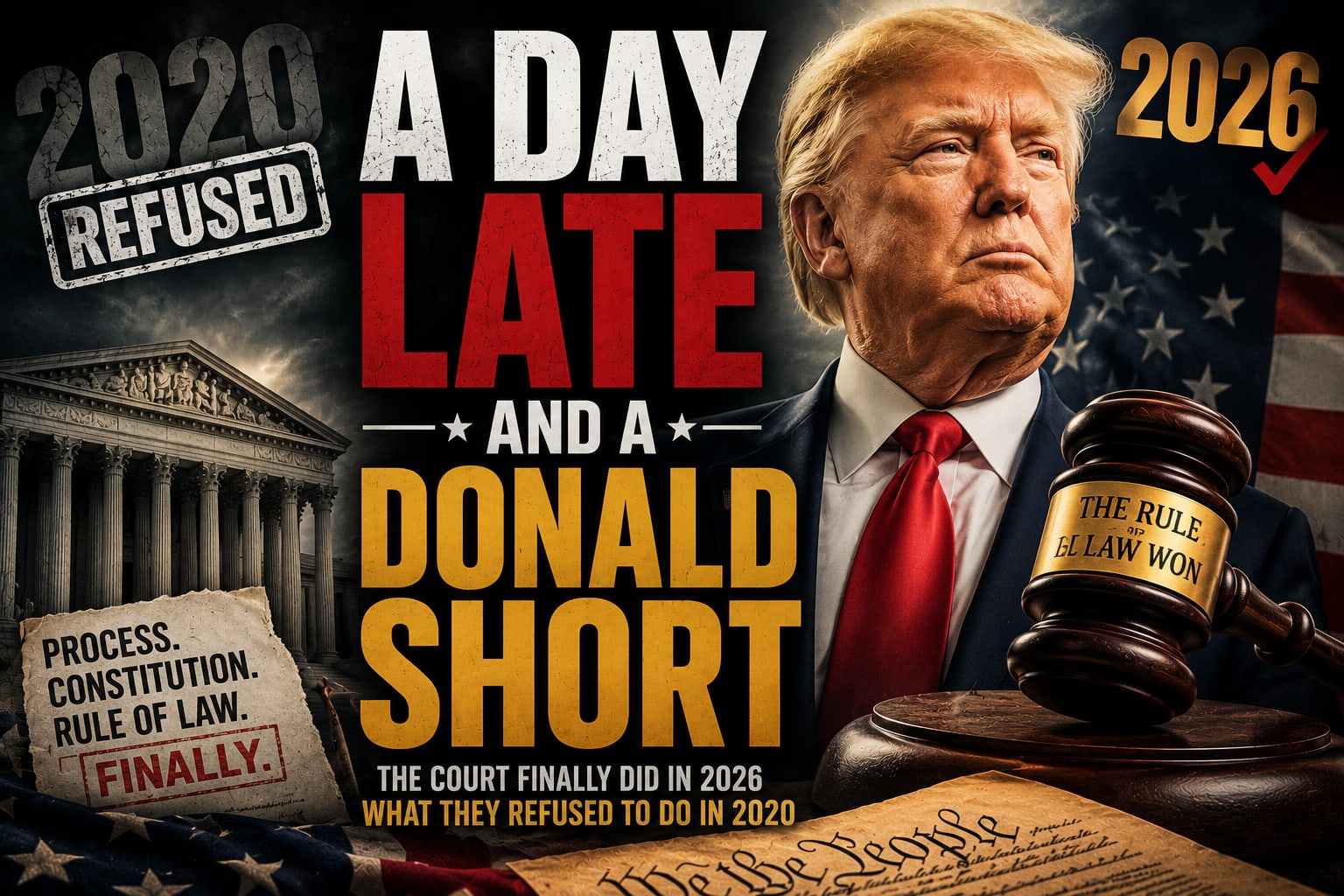
In 2026, in Virginia, the rule of law won.
In 2020, in America, the rule of law was buried under “shut up, the election is over.”
But the parallel runs deeper than process, folks. It runs all the way to the bones of the Constitution.
The Founders gave two specific powers to state legislatures — and only to state legislatures:
-
Article I, Section 4 — the legislature sets the time, place, and manner of congressional elections (including redistricting).
-
Article II, Section 1, Clause 2 — the legislature sets the manner of choosing presidential electors.
Both clauses use the same word. Legislature. Not “the state.” Not “the courts.” Not “the secretary of state.” Not “the governor.” The legislature.
In 2020, every single one of those swing-state Democrat secretaries of state and partisan courts didn’t just break a procedural rule. They stole a constitutional power that belonged to the legislature.
-
Boockvar in Pennsylvania stole the legislature’s Article II power when she rewrote ballot deadlines.
-
The Pennsylvania Supreme Court stole the legislature’s Article II power when it extended the mail-in deadline three days past Election Day.
-
Benson in Michigan stole the legislature’s authority when she mailed unauthorized absentee applications.
-
The Wisconsin Elections Commission stole the legislature’s authority when it rewrote drop box rules.
-
The Georgia Secretary of State stole the legislature’s authority when he signed a consent decree changing signature verification.
In every case, the unelected — or the wrongly elected — usurped a power the Founders gave to the elected legislature alone.
That is not a procedural foul. That is a constitutional theft.
And in 2020, every court that mattered looked the other way.
In 2026, in Virginia, four justices finally said: enough. The legislature has its constitutional power — and it must use that power inside the constitutional process. When it doesn’t, the act is void. Not “frowned upon.” Not “remanded.” Void.
That is the difference between 2020 and 2026.
Not evidence. Courage.
The Roberts Court in 2020 — and every battleground state court that ducked behind “standing” — refused to enforce Article I and Article II against the very officials who were violating them in plain sight.
The Virginia Supreme Court today enforced Article XII of its own state constitution against the legislature itself.
That’s what a real court does. That’s what real justices do. That’s what the rule of law looks like when it has a spine.
The truth, folks — and you can write this on the wall of every courthouse in this country:
When the rules break, the result breaks with them.
The Virginia Supreme Court remembered that today.
The American Republic forgot it five years ago.
And until we get that memory back, every election in this country will live under the shadow of the one we never had the courage to overturn.
And Now You Know…
THE BEST of the Story.
— Professor Toto TOTO FREE PRESS | Tomorrow’s News Today
Sources: Cardinal News, Virginia Mercury, Axios Richmond, The Hill, NBC News, WTVR, Fox News (2020 PA coverage), Just The News, Rep. Seth Grove (PA House), Texas v. Pennsylvania (U.S. Supreme Court filing, 2020).