
Something historic just happened in the oil world.
And it is going to hit your gas pump… your grocery bill… and the balance of power in the Middle East — all at the same time.
One of the richest countries on the planet just walked out of the most powerful energy cartel in human history. They didn’t slam the door…
They took the hinges off.
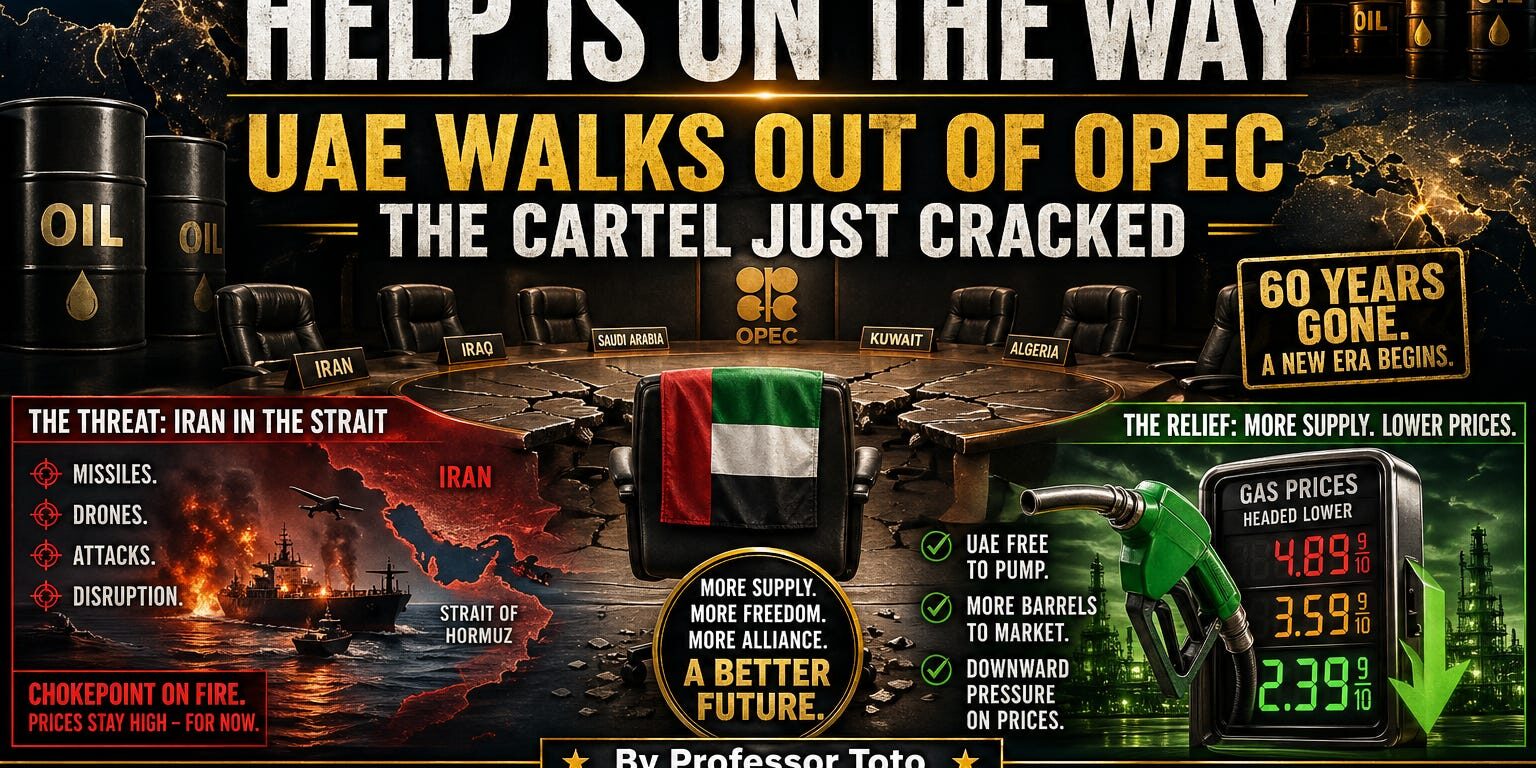
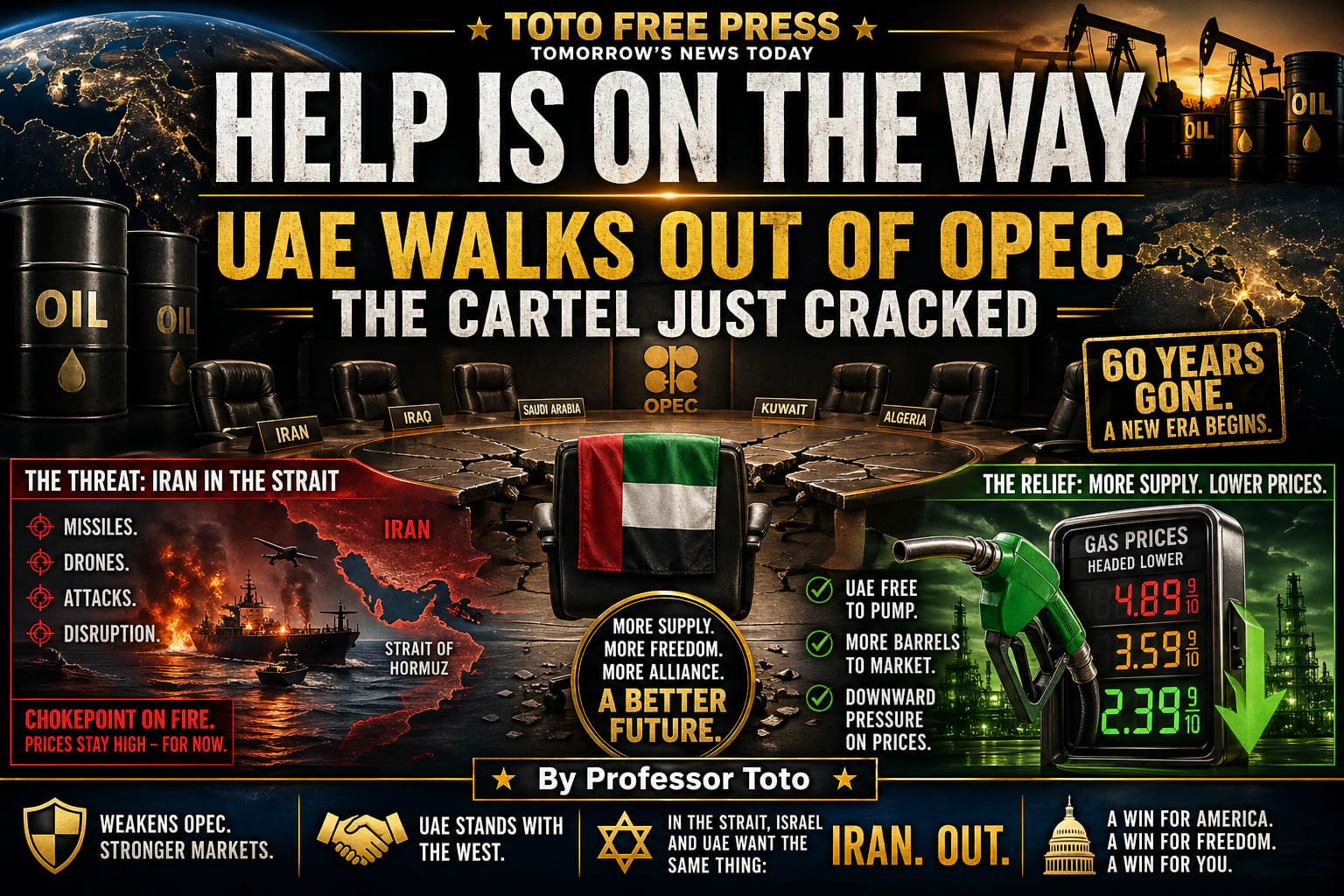
The United Arab Emirates is leaving OPEC effective May 1st.
Nearly sixty years of membership — gone in one announcement.
So What Is OPEC?
Picture a room.
In that room, the world’s biggest oil producers sit around a table and decide — together — how much oil they will pump and, by extension, how high they want the price to stay.
That’s the OPEC system. It has bossed the global economy for six decades.
The UAE has been in that room since 1967. One of OPEC’s most important Gulf members. Its third-largest producer, behind Saudi Arabia and Iraq.
Today… they got up, pushed back the chair, and walked out.
Why Now?
Because Abu Dhabi is FED UP.
For weeks, Iranian missiles, drones, and maritime attacks in and around the Strait of Hormuz have hammered Gulf shipping and crushed the UAE’s ability to export its crude — the lifeblood of the Emirati economy.
On paper, the UAE was capped at roughly 3.2 million barrels a day under its OPEC quota. But Abu Dhabi has spent years and billions building capacity beyond that — barrels they were never allowed to fully sell.
Inside OPEC, the rules were Saudi rules. The ceilings were Saudi ceilings. The pace was Saudi pace.
And meanwhile, Iran — sitting at the same OPEC table — was shooting at UAE tankers.
You can’t sit in a “brotherhood” with a regime that is actively targeting your ports.
UAE Energy Minister Suhail Al Mazrouei has confirmed Abu Dhabi is now pressing ahead toward 5 million barrels per day by 2027 — and outside OPEC, they have full freedom to get there at their own speed.
You cannot grow when somebody else is holding the throttle.
Especially when that somebody else needs high prices more than you do.
What This Means For YOU at the Pump
Now folks, let me give you the straight truth — not the cable-news cartoon version.
When the UAE walks out on May 1st, it is no longer bound by OPEC’s quotas or coordinated cutbacks. Abu Dhabi can pump what it wants, when it wants, and sell it to whomever it wants. Period.
In the long run — that means more supply on the global market and downward pressure on prices.
In the short run — traders are still glued to the war in the Strait of Hormuz, and as long as Iran has that chokepoint on fire, full price relief at the pump is going to be slow-walked, not overnight.
So here’s the real story:
This move weakens OPEC’s grip. It is a step toward cheaper fuel.
But the gas-pump payoff depends on one thing — shutting down Iran’s mischief in the Strait of Hormuz.
That’s the deal. That’s the truth. And that’s why this story matters far beyond oil.
For fifty years, Washington has wanted two things:
Less power for OPEC. More non-OPEC supply in friendly hands.
President Trump has hammered OPEC for “ripping off the world.” Today… one of OPEC’s biggest producers just handed him a wrecking ball.
And Don’t Miss The Bigger Story
This is not just about barrels.
This is about REALIGNMENT.
The UAE signed the Abraham Accords with Israel in 2020. They have deepened ties with Washington and Western markets ever since. They have built pipelines that bypass Iran’s chokepoint. They have built relationships that bypass Iran’s politics.
Iran sits in OPEC. The UAE sits in the Abraham Accords.
You cannot stay in a producers’ club with a country shooting missiles at your cities.
So Abu Dhabi did what sovereign nations do when survival and strategy collide:
They got up from the table that includes Tehran… And walked toward the side that includes Jerusalem and Washington.
In the Strait of Hormuz, Israel and the UAE now want the same thing:
Iran. Out.
Energy policy, security policy, and alliance structure are now lining up on the same side of the line. That is a tectonic shift in the Gulf balance of power — and most Americans will not hear about it on the evening news tonight.
You’re hearing about it here.
The Bottom Line
For nearly sixty years, OPEC controlled the price of the oil that moved the world — by limiting supply, coordinating cuts, and answering to a Saudi-centered system.
Today, one of its biggest producers — and one of Israel’s closest Arab partners — walked out the door. The cartel just lost its third-largest member and a major chunk of its spare capacity.
Help can be on the way at the gas pump… as UAE barrels gradually escape cartel discipline — if Iran’s war doesn’t choke off the export lanes.
Help is on the way for Israel and the West, as a key Arab power moves firmly into the camp opposed to Tehran’s aggression.
Help is on the way against the Tehran regime itself — which just lost a neighbor inside the OPEC tent and gained a determined rival with millions of barrels of leverage and a direct line to Western markets.
This… is a BIG deal.
And Now You Know… THE BEST of the Story.
— Professor Toto TOTO FREE PRESS — Tomorrow’s News Today